Freezer Repair
Why a Sub-Zero Freezer Frosts Over in Denver's Dry Air
Written by Curtis Mahoney Refrigeration technician — defrost and control faults · 16 years in the trade
Reads the defrost cycle before he reads the compressor: heater, terminator, then drain, in that order. A blocked drain and a dead heater present as the same sheet of ice, and only one of them is worth a part.
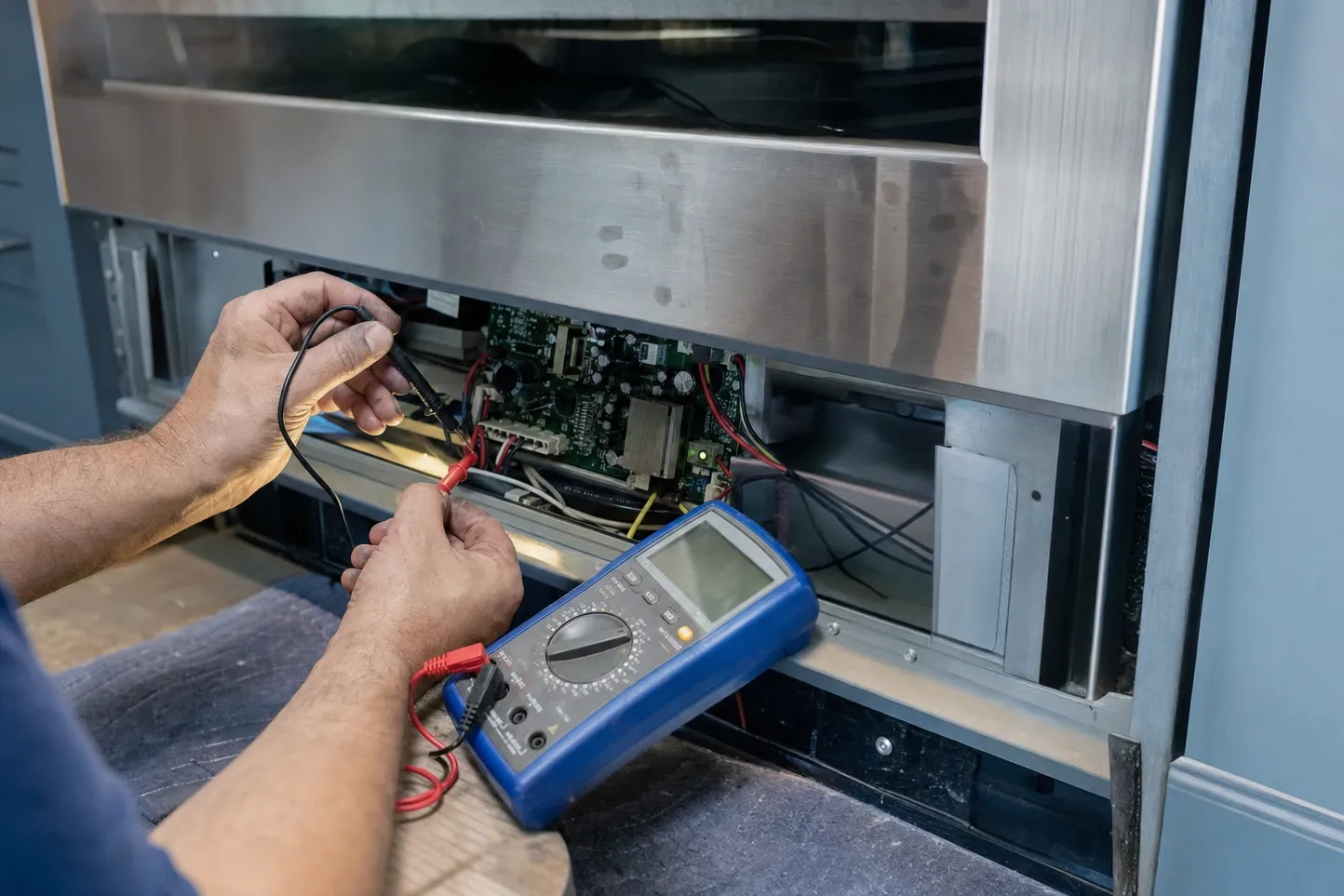
Of every freezer complaint that reaches this shop in Denver, a cabinet packing itself with ice arrives most often — and gets read wrong most often. Frost is not the fault. Frost is what a freezer does with the moisture it is given, and a sheet of it on the rear panel is the machine telling you either that warm air is getting in or that the ice it makes in normal use is no longer being cleared.
The distinction matters, because one of those is a twenty-minute repair and the other is a component failure that will keep coming back until it is replaced.
What frost is actually telling you
Behind the rear panel of a Sub-Zero freezer column or drawer sits the evaporator — the coil that gets cold. Air is pulled across it by a fan, moisture in that air condenses on the coldest metal in the cabinet, and it freezes there. Every freezer does this. That is why the machine has a defrost cycle at all: a heater warms the coil on a schedule, the frost melts, and the water leaves through a drain to a pan near the compressor.
So there are only two ways to end up with a cabinet full of ice.
The first is more moisture arriving than the cycle was designed to clear. A door seal that has taken a set, a drawer that no longer pulls itself shut, a hinge that has dropped a couple of millimetres — any of these lets room air trickle in continuously. You will often feel it as a cool edge along one side of the door, and the frost tends to be worst nearest the leak.
The second is the defrost cycle failing to run or failing to finish. Then the frost is even, thick and spread across the whole panel, and it grows week by week. Airflow drops as the coil packs solid, and the cabinet warms while the compressor runs more, not less — which is the detail that confuses people most. It sounds like it is working harder than ever, because it is.
The four faults behind a sheeted rear panel
In rough order of how often we find them on built-in freezers in this city:
- Door or drawer seal. The cheapest fault and the most common. Vinyl gaskets stiffen with age, and a seal that has taken a set stops touching the frame along part of its run. Frost forms nearest the gap.
- Defrost heater open circuit. The heater is a resistance element clamped to the coil. When it fails open, nothing else changes: the compressor still runs, the fan still turns, and ice accumulates until air cannot pass.
- Defrost thermostat or thermistor. The circuit needs to know when the coil is cold enough to need a defrost and warm enough to stop. A sensor reading wrong either skips the cycle or ends it early, and the symptom comes and goes in a way that makes it feel intermittent.
- Blocked drain. The cycle runs, the ice melts, and the water has nowhere to go. It refreezes at the base of the cabinet, often as a visible ridge under a drawer, and each cycle adds to it.
An actual sealed-system fault — low refrigerant charge, a failing compressor — does exist, but it is a distant fifth here, and it does not usually present as frost. It presents as a cabinet that never reaches temperature with a clean, dry coil.
Denver’s dry air changes the odds
This is where a local diagnosis differs from a generic one. Denver runs dry for most of the year; indoor relative humidity in a heated house through the winter is often well under thirty percent. Every door opening still carries moisture into the cabinet, but far less of it than the same door opening in Seattle or Chicago.
That has a practical consequence: in a dry climate, recurring heavy frost is weak evidence for ambient humidity and strong evidence for a mechanical fault. If a freezer here is packing ice onto the coil faster than the cycle clears it, something is either letting outside air in continuously, or the cycle is not clearing anything.
Two other local details are worth knowing. Kitchens and garages in this city swing hard — a sun-facing room or an attached garage can bake in the afternoon and drop twenty degrees after sunset, and an undercounter unit in that garage is being asked to reject heat into air far hotter than its rating for a few hours each day. And at five thousand two hundred and eighty feet, a low-side gauge reading is not the number a sea-level pressure chart prints, because the gauge is referenced to a lower atmospheric pressure. It is a small offset, and it is exactly the kind of small offset that makes a system look short of charge when it is really short of airflow.
What to check in ten minutes
Four things, none of which require tools you do not own.
Put a thermometer in the cabinet. Not the door display — an independent probe, in a drawer, left for an hour. A built-in freezer should hold near zero degrees Fahrenheit. Anything in the teens with a healthy-looking display points at airflow, which points at the coil.
Look at the frost pattern. Even, uniform frost across the whole rear panel means the defrost circuit. Frost concentrated at one edge, or around a corner of the door, means air is getting in there.
Test the seal with a strip of paper. Trap the strip in the shut door, then tug it. Resistance is the answer you want. Repeat around the top, down both sides and along the bottom of every door and drawer; wherever the paper comes away without a fight, room air is getting in, and that is your frost source.
Listen for the evaporator fan. With the door open, hold the light switch in. You should hear soft airflow behind the panel. Silence there, with a working compressor, is a fan or a fan circuit — and a fan that has stopped will frost a coil locally and quickly.
What is not worth doing is unplugging the unit for a few hours to reset it. It melts the ice, restores airflow and hands you a machine that looks fixed for about a week.
When it is worth calling
Call when the cabinet is above ten degrees Fahrenheit with food softening, when frost returns within a week of being cleared, when there is water or ice at the base of the cabinet, or when a drawer has stopped sliding because ice has built up behind it.
On a built-in the repair is almost always worth doing. These are cabinet-fitted machines with panels cut for the opening; the parts that fail here — heaters, thermistors, fan motors, seals — are ordinary parts, and the alternative conversation involves cabinetry as well as an appliance. The $89 service call covers the visit and the diagnosis and comes off the total if you approve the work, so the diagnosis is not a bet.
Bring the model and serial to the call if you can. They are inside the fresh food door on the upper left frame, and knowing them is the difference between a heater on the van and a heater on order.
Follow-ups
- Is some frost inside a Sub-Zero freezer normal?
- A light, even dusting on the rear panel is normal — that panel hides the evaporator, and frost forms there every time the door opens. What is not normal is frost that builds into a solid sheet, or frost that comes back within a week of being cleared.
- Should I just defrost it manually and carry on?
- It buys a few days and it destroys the evidence. Melting the ice restores airflow, so the cabinet reads normal again while the underlying fault — an open defrost heater, a split seal, a blocked drain — is untouched and still building the next sheet of ice.
- Why does the display still read zero when the food is soft?
- The display reports what the control thinks, based on a thermistor near the air path. With the evaporator iced over, air stops moving past that sensor, so the reading can stay believable while the far end of the cabinet climbs into the teens. A cheap thermometer sitting in the drawer settles the argument.