Denver Conditions · part 4 of 4 · Wine Cooler Repair
How a Sub-Zero Wine Cooler Works, Zone by Zone
Written by Curtis Mahoney Refrigeration technician — defrost and control faults · 16 years in the trade
Reads the defrost cycle before he reads the compressor: heater, terminator, then drain, in that order. A blocked drain and a dead heater present as the same sheet of ice, and only one of them is worth a part.
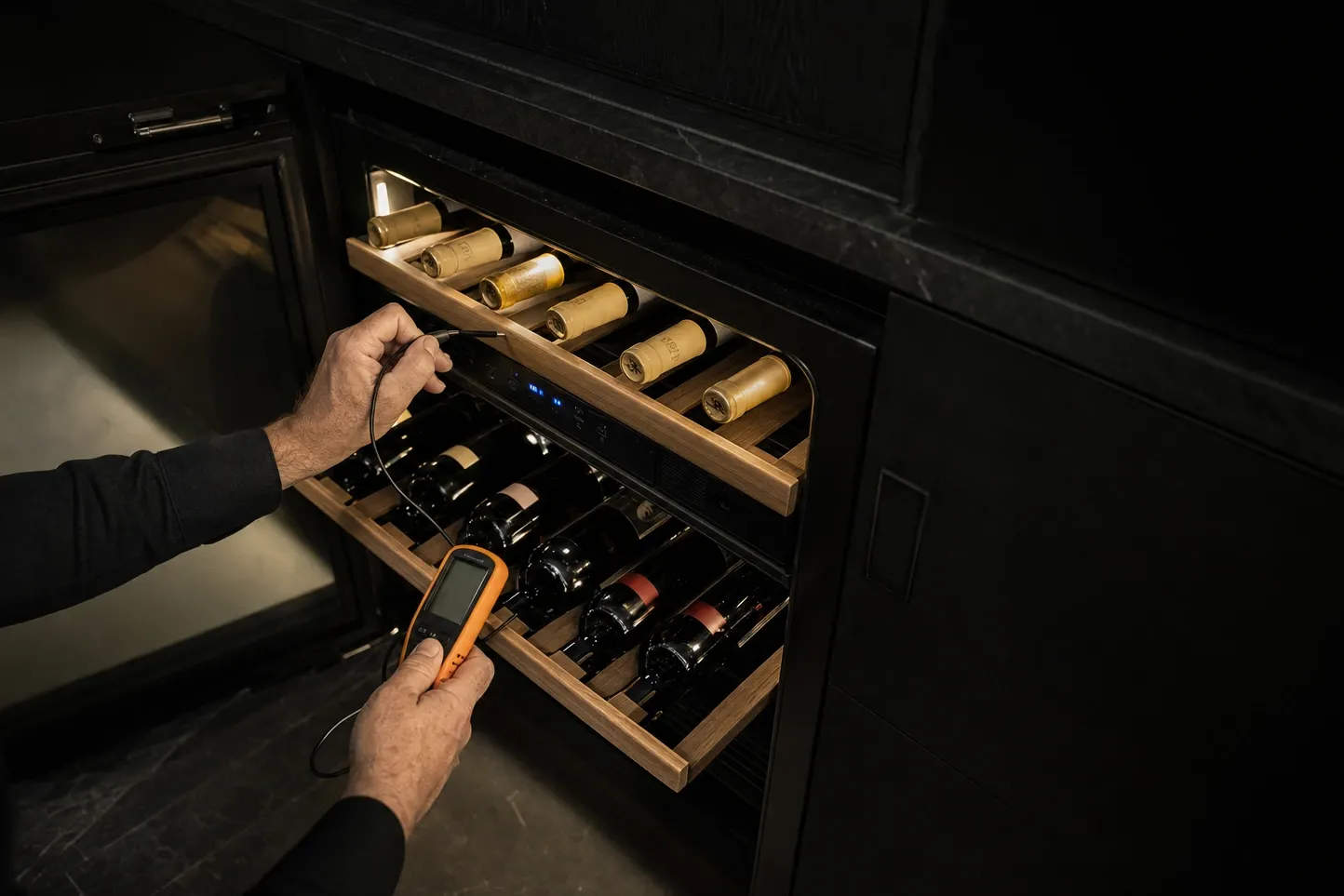
A wine cooler works the way a refrigerator does, only more gently. A sealed loop of refrigerant soaks up heat at a cold coil inside the cabinet, a compressor pushes that heat to a warm coil outside, and fans plus a pair of temperature sensors keep each zone parked at cellar temperature instead of fridge-cold. The goal is steadiness, not chill. That matters in Denver, where indoor air stays dry for much of the year and a rack on the dining-room wall rides every swing of the thermostat. Each part’s job also explains what owners notice: a warm zone, a puddle, a noise or a code.
The refrigerant loop that does the cooling
Inside the cabinet walls runs a closed circuit of tubing filled with refrigerant. At the evaporator, a finned coil behind the rear panel, the refrigerant boils at low pressure and draws heat out of the cabinet air. The compressor squeezes that vapor, raising its temperature, and sends it to the condenser, where a second fan blows room air across the coil and carries the heat off. On built-in and undercounter wine units the condenser breathes through a front grille, so dust packed against it shows up as a warm cabinet. Many small countertop coolers skip the compressor and use a thermoelectric plate instead; it is quiet, but it can only hold the inside a limited distance below the room. Sub-Zero wine storage uses a compressor.
Two sensors per zone and a control that listens
The control board does not guess. Each zone has a thermistor, a small sensor whose electrical resistance shifts with temperature, reading the cabinet air, and often a second one on the evaporator coil. When the air sensor reports the zone creeping above your setting, the board starts the compressor and the evaporator fan; once the target is reached, it stops them. Dual-zone cabinets repeat that logic for an upper and a lower compartment. Classic wine storage makes the layout visible in its codes: an air sensor reading open, shorted or inconsistent appears as EC 05 on top and EC 07 below, and a coil sensor fault as EC 06 or EC 08. Each of the four needs a technician, not a reset.
Why bottles want a cabinet of their own
Why have a wine cooler at all? A kitchen refrigerator is built to chill food fast and strip moisture from the air, and its door opens dozens of times a day. Wine keeps best somewhere cool but not cold, dark, still and unchanging. A dedicated cabinet holds the mid-fifties Fahrenheit that underground cellars settle at, keeps bottles lying down so corks stay moist, and uses tinted glass to cut light. Wine units are also designed to keep vibration low. Denver’s dry winter air adds one more reason: an open rack in a heated room can let corks dry out over a long cellaring, while a closed cabinet keeps its own small, stable climate.
Frost, defrost and the drain: where water comes from
Water inside or under a wine cooler nearly always traces back to the defrost path. Each time the evaporator runs, moisture from the cabinet air freezes onto its fins. The control periodically warms that coil, the frost melts, and the water runs down a trough into a drain tube that ends in a pan beside the condenser, where warm air evaporates it. If the tube clogs, meltwater backs up and spills onto the cabinet floor or out beneath the door. A pan that cracks or slides out of place moves the puddle to the kitchen floor. Beads of moisture along the door edge are a separate story: in Denver’s dry air they are uncommon, so when they appear, a tired door seal letting cold air escape is a likely culprit.
The sounds of normal operation, and the ones that are not
Silence is not the standard for a working wine unit. While the compressor cycles you will hear a gentle drone, along with moving air from the fans, the occasional relay click, and a gurgle as refrigerant travels the tubing. Ticking or popping as the coil warms and cools around a defrost is normal too. The noises that point to a fault have a different character. A scrape that keeps time with the fan usually means a blade is brushing frost or debris. A rattle from the base can be a loose drain pan. A compressor that hums, cuts out within seconds and tries again is worth a call before it overheats.
When a zone runs warm
Most warm-cabinet complaints come down to airflow, the door, a sensor or the sealed system. Start with airflow: vacuum the front grille and keep it clear. Then check the room. Sub-Zero’s instructions for some of its wine storage ask for a space that stays between 60°F (16°C) and 90°F (32°C), which rules out an unheated Denver garage in January, as our garage guide explains. Next, close a strip of paper in the door at several points; if it pulls out with no drag, the gasket has stopped sealing. When airflow and door both pass, a stalled evaporator fan, a failed sensor or a weak compressor comes next, and those call for diagnosis. On Classic wine storage, a sealed-system problem appears as EC 15.
Reading the alarms and codes on the display
The display is the unit naming the part it doubts. On Classic wine storage, EC 10 and EC 11 are warm and cold alarms for the upper compartment, and EC 12 and EC 13 the same pair for the lower one. On Designer wine storage, 40 1 09 means zone 1 has drifted far too warm or too cold, and 95 1 00 means that door stood open for 20 minutes or longer. For both Designer codes, clear anything blocking the door, switch the breaker off for 30 seconds and back on, and call if the code returns. A WS-30 built after a 2016 production change chimes once its door has been ajar for 60 seconds; earlier ones flash BELL ON and beep on a temperature problem instead.
Simple care, and when to bring in a technician
Day-to-day upkeep is short. Wipe the interior with mild soap and warm water, keep the grille free of dust, and keep the door gasket clean and supple so it seals. There is no water filter to replace, because Sub-Zero wine storage, apart from the IW-30CI, carries no internal filter. If a zone keeps drifting, water keeps appearing or a code comes back after a reset, our wine cooler repair service covers homes in Golden Triangle, Five Points, Virginia Village and Belcaro; phone (720) 770-4189. A diagnostic trip to your kitchen costs $89 flat, and approving the fix folds that amount into the repair rather than stacking it on top.
Follow-ups
- Why have a wine cooler instead of keeping wine in the kitchen refrigerator?
- A wine cooler holds bottles at a steady cellar temperature, while a kitchen refrigerator runs colder and drier and gets opened far more often. The food fridge is fine for a bottle you plan to open this week, but months in there can dry corks and flatten the wine. A dedicated cabinet also limits light and vibration and lets reds and whites sit at different settings.
- Why is my wine cooler leaking water?
- A blocked defrost drain is the usual reason a wine cooler leaks. Meltwater from the evaporator should run through a tube into a pan near the condenser; when the tube clogs, water backs up onto the cabinet floor or seeps out under the door. A cracked or shifted pan puts the puddle on your kitchen floor instead.
- Is it normal for a Sub-Zero wine cooler to make noise?
- Some sound is normal: a low compressor hum, soft fan air, relay clicks and a gurgle of moving refrigerant. Scraping that keeps time with the fan, a rattle from the base, or a compressor that starts and quits within seconds over and over are the noises that deserve a technician's look.
- How much does wine cooler repair cost in Denver?
- Wine cooler repair starts with an $89 diagnostic visit, and that fee is subtracted from the bill once you approve the work. Typical bands after that are $270–$680 for a door seal and $320–$700 for a fan motor, while sealed-system work runs $1,490–$3,180. The firm price comes only after the technician has found the cause.
Related reading: garage guide . The repair itself is booked as wine cooler repair service . For the cabinet itself, see Sub-Zero BI and classic built-ins, BI-30U through .